Thursday, September 26, 2013

Two nights in Bangkok


Remember the 80’s song: http://www.youtube.com/watch?v=P9mwELXPGbA? Well, Ana and Simon upgraded it from “One night in Bangkok” to two nights!

Ana has been working for more than half a year in Asia by now. She had hoped before that her work may allow her to do some business travel around the region. Finally, August presented a company training in Bangkok on a Thursday and Friday. She could check with Mercer and they allowed her to fly back to Singapore on Sunday instead and thus, Simon booked a flight to Bangkok to join her for the weekend. As they wanted to explore Thailand’s capital at some point anyhow, this basically just solved the question when to go there.

Simon met Ana in the afternoon of Friday. She staid in a down-to-earth business hotel in the Expat area of Bangkok, even though it still seemed pretty local to the European explorers. They went out for some drinks with Ana’s colleagues and continued to a pretty unique restaurant experience: “Cabbage & Condoms”. The food was mainly Thai and quite good. The interesting part of it was the decoration. All the lamps, pictures on the wall and lampions in the garden were created out of a multitude of different color-condoms. Other than that, the food was great and the atmosphere was a lot of fun. Saturday, they started their exploration of the city. All in all, Bangkok is a city full of contrasts. Ana and Simon did very “touristy” visits and major sightseeing, including temples, Thai houses and high rise buildings. 

In the garden of a very nice Thai building complex

Simon with the Thai ladies
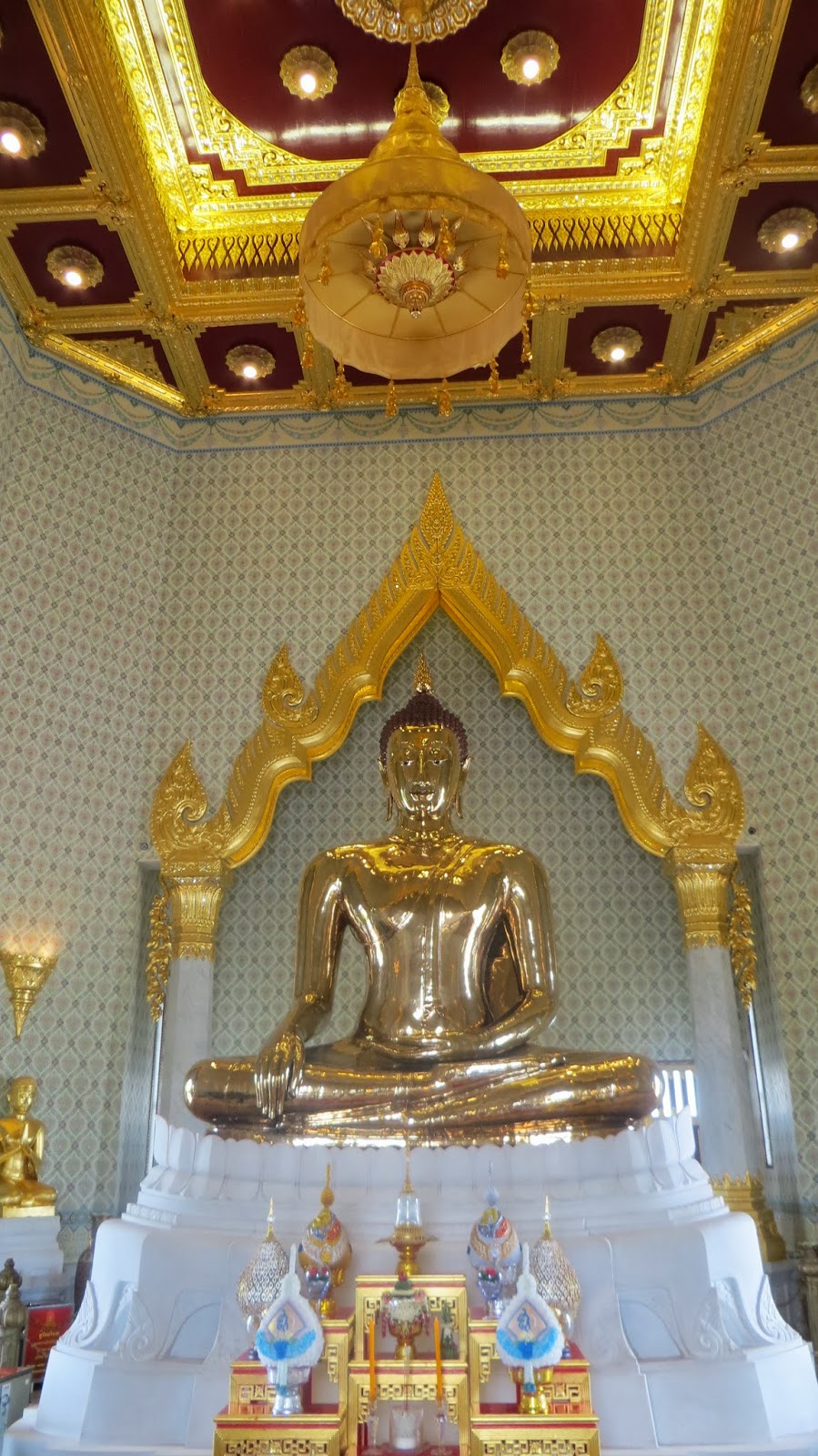
A major temple in Bangkok
The massive 2.5 ton pure gold Buddha inside the temple
The gate to Chinatown against the background of the Golden Buddha Temple
On the other hand, the city life seemed to be unaffected by either the fact that millions of tourists visit Bangkok every year or that it is the Thai capital and by far the largest city of the country. Just a few dozen meters off the main roads, the life seemed to be much calmer and even more exotic than what the average tourist would see. One of the highlights that should be on the travel agenda for  every tourist is definitely the Grand Palace. Thailand was the only country in the region that remained independent from any colonial powers and can look back at a long history as an empire. However, it also never reached the scale or expansion of some European powers or China. Nevertheless, the Grand Palace stunned Ana and Simon much more than any palace they had ever seen in Europe. Sorry Buckingham Palace, move over Palacio Real, not good enough Neuschwanstein. It combines a spiritual part with a huge temple complex, thousand of golden tiles, grand architecture with the political power of the Thai kingdom and large representative buildings for state affairs. Words are barely enough to describe it. In case any of the readers ever travel to Bangkok, make sure to reserve three hours or more and get a local guide to explain you everything. Ana and Simon didn’t have the luxury of time but would have loved to do this.

Amazing murals on the inner walls of the Golden Palace
View of the palace complex
Spectacular temples inside the Grand Palace
Ana and Simon inside the Grand Palace
Doing his duty for Thailand

Golden tiles wherever you look
Huge warriors protecting some of the buildings inside the palace
The actual main palace building
Another, less expected, highlight were the buzzling streets of Chinatown. It is not the “usual Chinatown” that gets recommended in the guide books. Basically, Ana and Simon were looking for a ferry on the mighty Chao Phraya river when they decided to explore an alley with a few spice shops. One more turn and they were in the midst of Chinatown, the only Westerners and amazed by the variety of products, spices, fruits and everything on offer.

Different spices in Chinatown
Not many Westerners around...
... but fresh fruit juice everywhere
Another fun experience in Bangkok are the night markets. They are basically a combination of some original cultural heritage (many goods would have been sold at night when cooler temperatures would be better for the sale of perishable goods) with modern pleasures of shopping after business hours and eating out for dinner. A rather new night market is called Asiatique and is accessible with a water shuttle only. Ana and Simon could enjoy some great seafood with a nice atmosphere right next to the river. Also, they were able to enjoy the fact that Bangkok is home to rooftop bars about 200m above ground. Quite a nice atmosphere, even though the city is missing a skyline. That is what’s happening when there is no civil engineering as in Singapore.

All in all, Thailand’s capital and its friendly inhabitants proved to be a very good weekend destination. Definitely to be recommended!
Local transport: River boat with monks

When in Bangkok - travel by tuk-tuk

Friday, September 13, 2013

The other George Town


If you hear about Georgetown, it is probably safe to assume that you will think about the one in Washington DC – Georgetown University and the number of embassies in that area of town are quite famous in the Western world. However, there is another George Town worth visiting – the main city of the Malaysian island of Penang and the first British founded settlement in the region. Before the foundation of Singapore, George Town was the most important administrative outpost for Britain in the region. Due to the somewhat superior location of Singapore right at the tip of the Malay peninsula and a natural stop over for foreign trade, George Town did decline in importance. This, however, brought its upsides as most of the old town was preserved and awarded UNESCO world heritage status in 2008.

When looking into destinations that are worthwhile visiting for just a weekend, George Town had been on Ana and Simon’s list. The airport of Penang is reachable within an 80 minutes flight and is served by major low-cost airlines – getting there is convenient and inexpensive. So the two decided to go there in July with another couple that they had met in Singapore: Edward and Charlotte. Edward is studying with Simon and Charlotte is working in Singapore just as Ana. They are a very nice couple – but this should be part of their blog ;-)

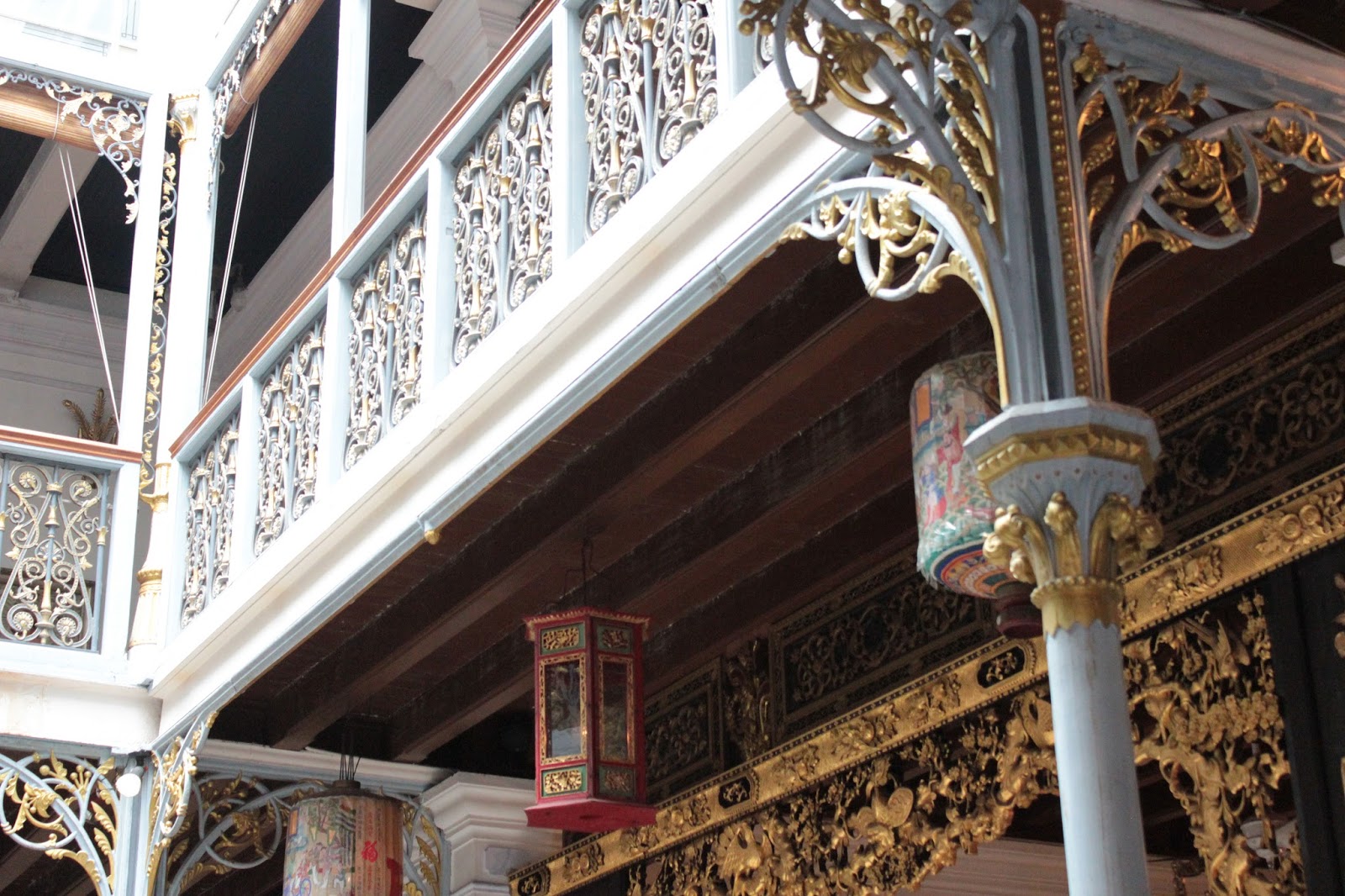
The four of them met at the Singapore airport on Friday evening and arrived in no time in Penang. They had booked a cute Bed & Breakfast in the old and very lovely city center of George Town. It was located in an old Chinese shop house. They basically shared the house which consisted of two suites and was mainly left in its original state from the 1920s except for the modern amenities / necessities like Air Conditioning. For dinner, they went to a hawker center which – similar to Singapore – carried a huge variety of Asian food offers at very affordable prices. They also could enjoy some Chinese live music (very much enjoyed by the audience, less by them) and a few Western songs (that they enjoyed but left the rest of the people basically unaffected). They finished their first night out with a few beers on the terrace in front of their home for the weekend and had gotten quite a positive first impression of George Town.

The entrance to our Chinese shop house
On Saturday, the group of four went to the North Western corner of Penang Island, home of the oldest national park of Malaysia. They had decided to go for a little jungle hike to the Western Coast. It was a very nice walk, about three kilometers, lots of ups and downs and amazing colors in the rain forest. They would even encounter a rather sizeable lizard on the way. They arrived at “Turtle Beach” after about 75 minutes and were taken back to the initial starting point of their expedition by boat. They enjoyed a late lunch of seafood before getting back to George Town.
Ana, the explorer

Turtle Beach

In the evening, they went to have dinner at China House, a restored Chinese storage hall that would occupy the length of a full block – probably 200 meters in length. They had read about it and were amazed by the combination of Western and Asian food, as well as their great selection of cakes for desert. It was so good that they decided to come back there the next day for a late lunch before flying back to Singapore and they were not disappointed the second time either. The place also had a wide variety of games and in case you hadn’t read it in the news: Ana, Simon and the British couple build the tallest Jenga-Tower in Southeast Asia on Sunday ;-). On Saturday night, however, they were caught in a big tropical thunderstorm and after waiting for thirty minutes for the rain to stop, they finally decided just to run back to the hotel (getting completely soaked) where they changed into the provided Chinese bathrobes and finished the evening with a bottle of wine.

On Sunday, the four Western tourists explored most of the actual city of George Town – from colonial churches to an old British fort to Chinese settlements on poles in the ocean. The highlight was definitely the trip up to Penang Hill, a small peak that gave them a great panoramic view of the area, including the mainland of Malaysia. It was also a few degrees cooler than in steamy George Town and Simon enjoyed the fact that he could get a cold German beer. Paulaner can be found almost anywhere in Southeast Asia!

The main Mosque in Penang


Street art

Chinese town house


The four traveler on Penang Hill
As promised, German beer with a view

All in all, it was a very nice weekend trip and is definitely to be repeated, also with Edward and Charlotte that turned out to be great sports.

Saturday, August 31, 2013

INSEAD – not only a business school but also home to social events


This blog entry is going to talk a bit more about INSEAD, Simon’s educational home for this year. The primary reason for Simon to choose the school over others, as mentioned before, was its very good reputation and the international network. In his first few terms, he did have a lot to work – it was really like a full time job with hours only a bit less than in his consulting work. On top of that it turns out, however, that it is also a lot of fun. INSEAD is hosting a number of social activities and involves the student’s “partners” (girlfriend / boyfriend / wife / husband) quite well. Some of the activities have already presented to you in this blog, be it the Heart of Europe national week or just travel events with a number of students.

The INSEAD cabaret
Twice a year, the artistic talent of the student body is brought out in an impressive way. INSEAD goes cabaret. A big organizational team put together a show that ranged from music performances to choreographic dances or even slapstick comedy. The most amazing parts of the cabaret were the creativity of the 13J students (the ones graduating in July) for whom it was the final social activity and they re-texted some popular songs to fit into their INSEAD experience. Also, the group of students from the Indian subcontinent would have an amazing dance prepared and the Chinese students had practiced a Panda dance, including a fun video that was rolling in the background. The highlight is every year the men's ballet. The choreography was actually taught by a student with 10 years of ballet experience... The execution was left to the male students graduating in July 2013. This activity will be repeated once in December before Simon’s promotion graduates – Ana and Simon are already looking forward to that now!
The MCs

INSEAD's infamous men's ballet


National Bidding Day
The concept of the national week was already presented to you in the Heart of Europe blog. Well, these national weeks are really a big thing and in order not to interfere with the academic activities too much, there are a limited number of possible weeks per year. Since there are more nationalities / regions that are interested in presenting themselves, they need to lobby for student support which is done on the National Bidding Day. When it happened, the students from Lebanon, the Indian subcontinent (“DESI”), Portugal, Eastern Europe (“Soul of Eurasia”), the US, Canada and Africa would present themselves with stands on campus, serving national food and having several exhibitions. Especially the crowds from Lebanon and DESI were very loud and optimistic, having a large number of students from the respective countries and they even had a belly dancer who would give a spectacular performance. When it came to the actual voting, each country had  10 minute time slot to present themselves which was normally done with a video and some sort of dance. DESI really hit it off with a whole “Bollywood” type soap opera produced as well as dancing on the stage. Afterwards, we had some more national drinks at the courtyard at INSEAD – a great way to spend a Friday.

The Portugese team

Jalla Lebanon
The three Spanish ladies (too few for a team) just dressed up nicely anyhow

DESI - Pakistani and Indians finally united!
The INSEAD Olympics
Furthermore to the academic and the fun challenges at INSEAD, there is also a competition involving sports. A consulting firm sponsored event, the BCG Olympics, is held on a Sunday in Sentosa Island, the weekend getaway island connected to Singapore via a bridge. On a large beach area, students from all sections (the “classes”) would get together and compete against each other in events such as beach volleyball, swim relay, beach soccer and dodge ball. Simon helped the beach soccer team to secure a second place whereas Ana helped on the swim relay.. There were also a lot of fun activities for “extra points” such as building a human pyramid. At this stage, the “mascot” of Simon’s section needs to be mentioned. One of his fellow students was in Singapore with wife and kid. 2 year old Ike would be involved in almost every INSEAD activity during the day – also at the Olympics. So no wonder that at the end, he would be on the top of the pyramid lifted up by his mum. Simon’s section ended up winning the overall competition with great support from Ana which they celebrated with a trophy in class.

The winning pyramide

Where are the people from? (Roughly a globe)

People would get quite competitive!

The DASH
A tradition on the Singapore campus developed years ago that saw a few students dressing up in costumes and going to school like that for a day. Well, it really becomes fun when 95% of the students are doing that and are always motivated to beat the spirit of the prior class. In 2013, this meant that people would hire the most spectacular or just plainly ridiculous costumes. A group of students was dressed as the Angry Birds, the whole Star Wars saga was present and some characters were not quite recognizable but fun nevertheless. They would all meet around 7:30 am in front of one of the apartment blocks were most students lived and then make a procession to school – much to the amazement of the Singaporeans that they passed, including a number of school kids since they were passing a high school on the way. Sounds a bit weird? Well, it definitely was but much more fun if one participated in it. Also Ike, our section mascot was helping his dad look great. The most random costume though was a student dressed like a shark with a very, very big head... and do not forget it was still 30 degrees Centigrade and quite humid...

Ike (our section mascot) with his dad James

Just another day in class

INSEAD angry birds

Sharks crossing

All in all, INSEAD is not only the “Business School for the World” but also a very fun experience for both, Ana and Simon.

Saturday, August 10, 2013

Borneo!


One of the less well-known travel destinations in Southeast Asia is the Eastern part of Malaysia. Malaysia is situated on both sides of the Strait of Singapore with its capital Kuala Lumpur and more than 75% of its total population living in “peninsular Malaysia”, the Southeastern part of mainland Asia. The Eastern part of Malaysia then is situated on the third largest island of the world – Borneo. Borneo is also the only island that has three countries on its surface: Malaysia, Brunei and Indonesia. The southern part of Borneo-Malaysia then is located around the multicultural city of Kuching – the destination of one weekend travel adventure for Ana and Simon.

Borneo is not only the third largest island in the world but also contains the oldest still-existing rain forest. This is home for populations of the Orang-Utans, besides Chimpanzees and Gorillas they are the closest relative of the human in the animal kingdom. Close to Kuching is a wildlife reservation for these Orang-Utans that are endangered by the excessive use of their habitat by humans and this is one of the main draws for visitors. Ana and Simon went there on an early Saturday morning with their own Malaysian tour guide. The reservation has two feeding hours per day and when you are lucky, the visitor can see up to 10 different Orang-Utans coming for bananas, pineapples or carrots. The sight of the Forest People (literal translation of the name Orang-Utan) is quite impressive. They are very gracious and athletic, moving from one tree to another or also just climbing up and down on one trunk. Ana and Simon took many pictures and it is probably best to let the pictures speak.


The facial expressions of the Orang-Utans and their social behaviors among each others really resemble humans. Their arms are much longer in relation to their body and they can also grab onto trees or branches with their feed, effectively they have 4 hands. You may also see one of the Orang-Utans hanging down from one branch with its two feet grabbed firmly around the tree and eating a banana hanging upside down; impressive. There were also a number of baby Orang-Utans that would hold tightly to their mothers and be pretty ok with any movement from one side of the jungle to the other.

Another stop on Ana and Simon’s tour of Borneo were the long-houses. These places are inhabited by the original people of Borneo and are basically houses about 2 m above the ground on long palisades to prevent animals or occasional floods to enter the living area that are joined to each other and thus may form a row of houses a few hundred meters long. Ana and Simon imagined these houses to be a bit more rustic as in fact, the “benefits” of civilization (esp. TV and beer) had already made their way through the jungle. It looked a little less remarkable. However, the drive to the long houses was a scenic ride and their guide would show them a pepper plantation on the way – quite nice to see where the pepper comes from!

Raw pepper
And processed

A creek in the jungle where most of the longhouses were located
While Ana and Simon were only in Kuching and surroundings for a bit more than 36 hours, they quite enjoyed the relaxed and multicultural vibe of the capital of Sarawak (the Malaysian state). Interestingly enough, Kuching and Sarawak were part of a “private kingdom” until World War II that was founded by the British adventurer James Brooke in the 1800s and run as a monarchy of the so-called “White Rajahs”. Only after World War II, it was governed as a part of the British Malay colony and gained independence in the 1960s. Kuching had a great history as a trading port with a lot of Chinese influence. Besides the Malay population, there are also a lot of indigenous people from Borneo living there. While Malaysia is a primarily Muslim country, Kuching has a number of Chinese temples and Christian churches and while this may be reason for troubles in many parts of the world, it creates diversity with a laid-back charm that Ana and Simon found unique in their Southeast Asian travel adventures. They enjoyed delicious seafood in one of the hawker centers, beers on the promenade at a Lebanese restaurant and they even listen to Un Canto a Galicia from Julio Iglesias (Galician music!!!) in one of the colonial bars. 
The state parliament on the Sarawak river

Entrance to Kuching Chinatown

Spot the European (hint - she's a bit taller!)

If anyone looks into the off-beaten path of traveling in the region, Kuching should make it to your travel list.