Saturday, August 31, 2013

INSEAD – not only a business school but also home to social events


This blog entry is going to talk a bit more about INSEAD, Simon’s educational home for this year. The primary reason for Simon to choose the school over others, as mentioned before, was its very good reputation and the international network. In his first few terms, he did have a lot to work – it was really like a full time job with hours only a bit less than in his consulting work. On top of that it turns out, however, that it is also a lot of fun. INSEAD is hosting a number of social activities and involves the student’s “partners” (girlfriend / boyfriend / wife / husband) quite well. Some of the activities have already presented to you in this blog, be it the Heart of Europe national week or just travel events with a number of students.

The INSEAD cabaret
Twice a year, the artistic talent of the student body is brought out in an impressive way. INSEAD goes cabaret. A big organizational team put together a show that ranged from music performances to choreographic dances or even slapstick comedy. The most amazing parts of the cabaret were the creativity of the 13J students (the ones graduating in July) for whom it was the final social activity and they re-texted some popular songs to fit into their INSEAD experience. Also, the group of students from the Indian subcontinent would have an amazing dance prepared and the Chinese students had practiced a Panda dance, including a fun video that was rolling in the background. The highlight is every year the men's ballet. The choreography was actually taught by a student with 10 years of ballet experience... The execution was left to the male students graduating in July 2013. This activity will be repeated once in December before Simon’s promotion graduates – Ana and Simon are already looking forward to that now!
The MCs

INSEAD's infamous men's ballet


National Bidding Day
The concept of the national week was already presented to you in the Heart of Europe blog. Well, these national weeks are really a big thing and in order not to interfere with the academic activities too much, there are a limited number of possible weeks per year. Since there are more nationalities / regions that are interested in presenting themselves, they need to lobby for student support which is done on the National Bidding Day. When it happened, the students from Lebanon, the Indian subcontinent (“DESI”), Portugal, Eastern Europe (“Soul of Eurasia”), the US, Canada and Africa would present themselves with stands on campus, serving national food and having several exhibitions. Especially the crowds from Lebanon and DESI were very loud and optimistic, having a large number of students from the respective countries and they even had a belly dancer who would give a spectacular performance. When it came to the actual voting, each country had  10 minute time slot to present themselves which was normally done with a video and some sort of dance. DESI really hit it off with a whole “Bollywood” type soap opera produced as well as dancing on the stage. Afterwards, we had some more national drinks at the courtyard at INSEAD – a great way to spend a Friday.

The Portugese team

Jalla Lebanon
The three Spanish ladies (too few for a team) just dressed up nicely anyhow

DESI - Pakistani and Indians finally united!
The INSEAD Olympics
Furthermore to the academic and the fun challenges at INSEAD, there is also a competition involving sports. A consulting firm sponsored event, the BCG Olympics, is held on a Sunday in Sentosa Island, the weekend getaway island connected to Singapore via a bridge. On a large beach area, students from all sections (the “classes”) would get together and compete against each other in events such as beach volleyball, swim relay, beach soccer and dodge ball. Simon helped the beach soccer team to secure a second place whereas Ana helped on the swim relay.. There were also a lot of fun activities for “extra points” such as building a human pyramid. At this stage, the “mascot” of Simon’s section needs to be mentioned. One of his fellow students was in Singapore with wife and kid. 2 year old Ike would be involved in almost every INSEAD activity during the day – also at the Olympics. So no wonder that at the end, he would be on the top of the pyramid lifted up by his mum. Simon’s section ended up winning the overall competition with great support from Ana which they celebrated with a trophy in class.

The winning pyramide

Where are the people from? (Roughly a globe)

People would get quite competitive!

The DASH
A tradition on the Singapore campus developed years ago that saw a few students dressing up in costumes and going to school like that for a day. Well, it really becomes fun when 95% of the students are doing that and are always motivated to beat the spirit of the prior class. In 2013, this meant that people would hire the most spectacular or just plainly ridiculous costumes. A group of students was dressed as the Angry Birds, the whole Star Wars saga was present and some characters were not quite recognizable but fun nevertheless. They would all meet around 7:30 am in front of one of the apartment blocks were most students lived and then make a procession to school – much to the amazement of the Singaporeans that they passed, including a number of school kids since they were passing a high school on the way. Sounds a bit weird? Well, it definitely was but much more fun if one participated in it. Also Ike, our section mascot was helping his dad look great. The most random costume though was a student dressed like a shark with a very, very big head... and do not forget it was still 30 degrees Centigrade and quite humid...

Ike (our section mascot) with his dad James

Just another day in class

INSEAD angry birds

Sharks crossing

All in all, INSEAD is not only the “Business School for the World” but also a very fun experience for both, Ana and Simon.

Saturday, August 10, 2013

Borneo!


One of the less well-known travel destinations in Southeast Asia is the Eastern part of Malaysia. Malaysia is situated on both sides of the Strait of Singapore with its capital Kuala Lumpur and more than 75% of its total population living in “peninsular Malaysia”, the Southeastern part of mainland Asia. The Eastern part of Malaysia then is situated on the third largest island of the world – Borneo. Borneo is also the only island that has three countries on its surface: Malaysia, Brunei and Indonesia. The southern part of Borneo-Malaysia then is located around the multicultural city of Kuching – the destination of one weekend travel adventure for Ana and Simon.

Borneo is not only the third largest island in the world but also contains the oldest still-existing rain forest. This is home for populations of the Orang-Utans, besides Chimpanzees and Gorillas they are the closest relative of the human in the animal kingdom. Close to Kuching is a wildlife reservation for these Orang-Utans that are endangered by the excessive use of their habitat by humans and this is one of the main draws for visitors. Ana and Simon went there on an early Saturday morning with their own Malaysian tour guide. The reservation has two feeding hours per day and when you are lucky, the visitor can see up to 10 different Orang-Utans coming for bananas, pineapples or carrots. The sight of the Forest People (literal translation of the name Orang-Utan) is quite impressive. They are very gracious and athletic, moving from one tree to another or also just climbing up and down on one trunk. Ana and Simon took many pictures and it is probably best to let the pictures speak.


The facial expressions of the Orang-Utans and their social behaviors among each others really resemble humans. Their arms are much longer in relation to their body and they can also grab onto trees or branches with their feed, effectively they have 4 hands. You may also see one of the Orang-Utans hanging down from one branch with its two feet grabbed firmly around the tree and eating a banana hanging upside down; impressive. There were also a number of baby Orang-Utans that would hold tightly to their mothers and be pretty ok with any movement from one side of the jungle to the other.

Another stop on Ana and Simon’s tour of Borneo were the long-houses. These places are inhabited by the original people of Borneo and are basically houses about 2 m above the ground on long palisades to prevent animals or occasional floods to enter the living area that are joined to each other and thus may form a row of houses a few hundred meters long. Ana and Simon imagined these houses to be a bit more rustic as in fact, the “benefits” of civilization (esp. TV and beer) had already made their way through the jungle. It looked a little less remarkable. However, the drive to the long houses was a scenic ride and their guide would show them a pepper plantation on the way – quite nice to see where the pepper comes from!

Raw pepper
And processed

A creek in the jungle where most of the longhouses were located
While Ana and Simon were only in Kuching and surroundings for a bit more than 36 hours, they quite enjoyed the relaxed and multicultural vibe of the capital of Sarawak (the Malaysian state). Interestingly enough, Kuching and Sarawak were part of a “private kingdom” until World War II that was founded by the British adventurer James Brooke in the 1800s and run as a monarchy of the so-called “White Rajahs”. Only after World War II, it was governed as a part of the British Malay colony and gained independence in the 1960s. Kuching had a great history as a trading port with a lot of Chinese influence. Besides the Malay population, there are also a lot of indigenous people from Borneo living there. While Malaysia is a primarily Muslim country, Kuching has a number of Chinese temples and Christian churches and while this may be reason for troubles in many parts of the world, it creates diversity with a laid-back charm that Ana and Simon found unique in their Southeast Asian travel adventures. They enjoyed delicious seafood in one of the hawker centers, beers on the promenade at a Lebanese restaurant and they even listen to Un Canto a Galicia from Julio Iglesias (Galician music!!!) in one of the colonial bars. 
The state parliament on the Sarawak river

Entrance to Kuching Chinatown

Spot the European (hint - she's a bit taller!)

If anyone looks into the off-beaten path of traveling in the region, Kuching should make it to your travel list.

Sunday, July 28, 2013

A fun weekend trip to Bali


Ana and Simon had already traveled the region quite a bit, be it with friends from Europe (read “Beautiful Thailand”) or INSEAD students (read “Asia for Advanced Travelers”). As a birthday celebration present to themselves, they decided to join some INSEAD students that had become good friends for a weekend in Bali in early April. This trip was different to the extent that they would travel as a group of 9 while the trip to Vietnam was somewhat opportunistic with a large group that would change often and Thailand was a “two couple trip”. This time Ana, Simon and 7 others would get a Villa in Bali to spend the weekend together. The overall group consisted of three Canadians, two Brazilians, two Germans, one Argentinean and one Spaniard – a good mix of backgrounds as well as some couples and some singles. They were also joined by a Dutch couple that would stay somewhere else. The day they left was Simon’s birthday and Ana had offered to prepare delicious paella for Simon and the crowd. Since the Villa where they stayed had a well-equipped kitchen, it just needed some fresh ingredients and some improvisation and Friday night was ready to kick-off. After some type of magic in the kitchen, the international group was amazed by Ana’s cooking skills and they enjoyed a Paella “Indonesian style” in an amazing house in Bali. Simon even got a birthday cake. So thoughtful!
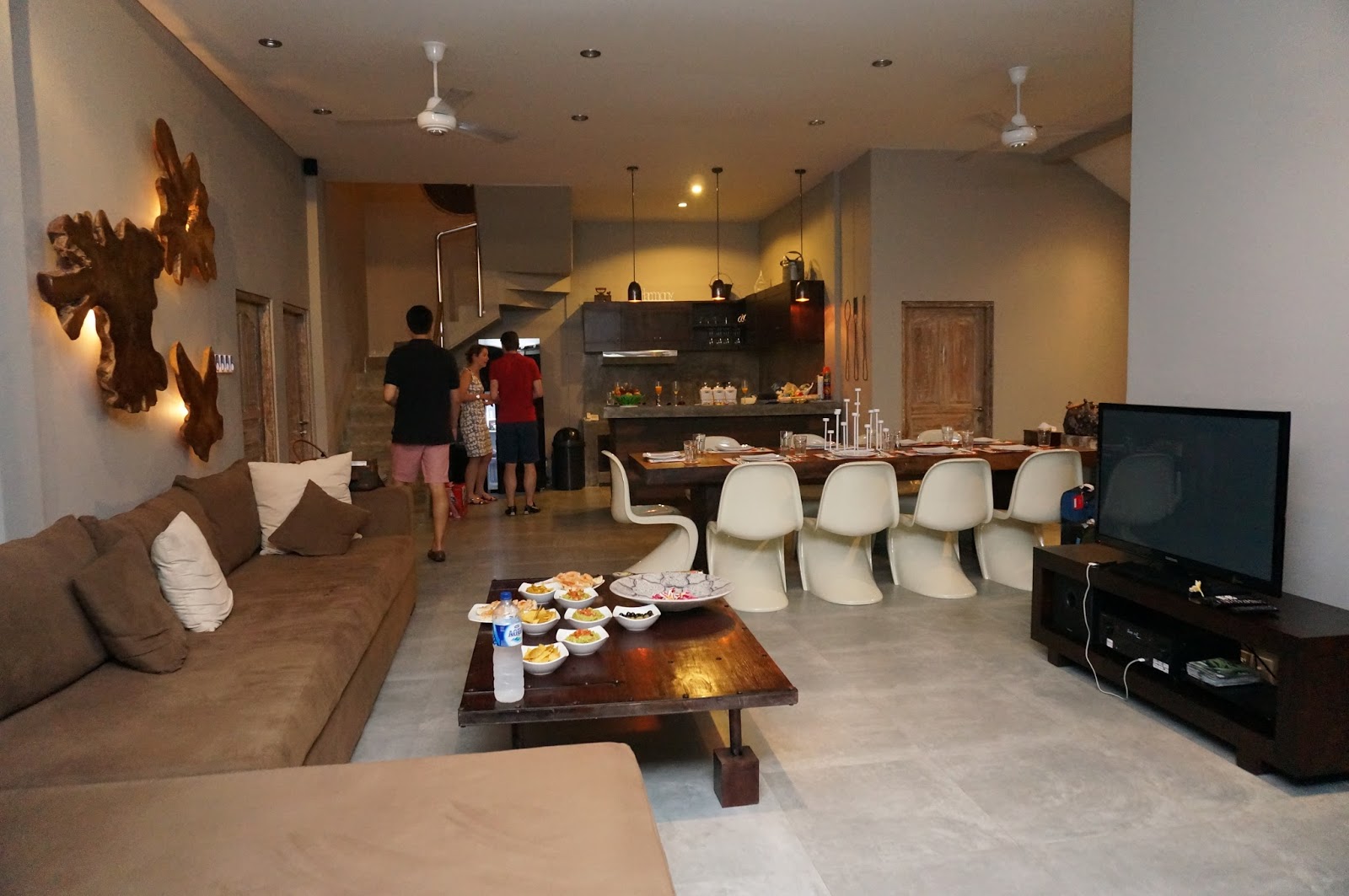
The living area of the Villa with the kitchen in the background

Small but relaxing pool

Three pans / woks of Paella lined up

The girls are singing for Simon

Since the Paella went along with a few glasses of wine, the night was short as Saturday saw the group to “rise and shine” at 7AM. They had booked a bike tour around the hills of Bali and despite the fact that they were all tired; an amazing day lay ahead off them.

Bali is a primarily Hindu island in the archipelago of Indonesia – the largest muslim country by population in the world. Thus, it has distinctive characteristics that can only be found there – three Hindu temples in every little town, roadside decorations on every light pole, little donations in form of fruits in front of most houses. Also, Bali is an island with two different faces – one place is rather touristy, comparable to Cancun or Palma de Mallorca whereas the hinterland of the island gives a feeling of being almost untouched, like the Mayan towns in Yucatan or some distant bays in Mallorca.

The travel group was picked up with a minibus and they turned north direction to the center of the island. Bali is of volcanic origin and they would mostly go uphill. First stop on their way was a coffee plantation where they tried a number of different coffees, each of them pretty delicious and tasty. Afterwards, the group had breakfast at a restaurant overviewing a lake that was created after the eruption of a nearby volcano in the 1960s.

Bali Coffee Tasting

The travel group and a volcano
Strengthened, they would be brought to the assembly point for their bike journey. With modern mountain bikes, a larger group of about 25 people explored a 12 km track of the island – passing towns that rarely see tourists with children giving high-fives to the bikers and always saying “hello, hello” to the group. The colors of the rice fields, the sky and the backdrop of the villages were amazing. The tour went largely downhill so it was more rolling than biking but in case anyone is ever interested in going to Bali, Ana and Simon would definitely recommend doing such a tour. The end point of the tour was an excellent lunch menu at the house of one of the tour guides. Yummy Indonesian food.
The "INSEAD Bike Group"


Spectacular colors

Hindu temples
Indonesian lunch buffet

In the afternoon, they relaxed a little bit and went to enjoy the sunset at a beachclub – basically a bar / restaurant with a country club style directly at the waterfront. Ana and Simon also hit the powerful Bali waves and understand why it is also a good tourist destination for surfers. After a very delicious dinner, they had a few drinks at the Villa before deciding to go out to a club. Since Bali is relatively close to Australia and famous for surfing, the majority of the partygoers were 20 something Australian surfers. It was amazing to see that not being in their early 20s actually made them old at this venue!

After the excitement of the bike trip on Saturday, Sunday was mainly a relaxed day at another beach club, including some drinks at the pool bar, delicious burgers and an incredible atmosphere – despite the fact that it was only a weekend getaway trip, it really felt like a well-deserved break from work and studying. They ended their Bali weekend adventure with a seafood dinner on the beach before heading back to the airport.
Tough life at one of Bali's beach clubs :-)

Ana and Simon really enjoyed Bali and will make sure to go back.

Thursday, July 11, 2013

What it means to live in Singapore – Part 2


In May, Ana and Simon already shared with you what it means to live in Singapore when it comes to Food/Drinks as well as Regulation (http://ana-and-simon2013.blogspot.sg/2013_05_01_archive.html).

Today, there are some more specialties about living in this Southeast Asian metropolis – the melting pot of the region.

Diversity
By its location, it could be expected that Singapore would be mainly inhabited by Malay people, the majority of the population of neighboring Malaysia from which it is separated by the Strait of Johor, a less than 1km wide stretch of water that makes Singapore an island rather than the most Southeastern point of Eurasia. However, about 75% of the population are ethnic Chinese. On the one hand, Chinese traders have been living and working in the South-China-Sea area for centuries and represent significant minorities in many countries across the region. On the other hand, the British – ruler of Singapore for almost 150 years – also encourage Chinese immigration to Singapore for cheap labor and trade. About 15% of the citizens of Singapore are actually Malay and around 10% are Indian, primarily from the Southern States of India, speaking Tamil. Thus, Singapore has not one, not two but four official languages – besides English which was used for centuries for administrative purposes, the ethnic mix is represented with the official languages Mandarin (Chinese), Malay and Tamil. Moreover, the mix of people also means that they bring a very diverse religious mix – Many Chinese were Christianized or Buddhist, Indians were Hindu or Muslim and Malay and Arab traders also followed Islam.
Thus, there is a multitude of religious buildings and many are quite impressive.

One of the major Hindu Temples
The large Buddha Tooth Relic Temple in Chinatown
The major mosque, close to Arab Street
This somewhat unique mix of nationalities and religions brings a diversity of public holidays that is incredible: Chinese New Year in February, Good Friday and Christmas as Christian holidays, Vesak Day in May is a Buddhist holiday, August sees the breaking of the fast (Muslim holiday – Hari Raya Puasa) and October the other Muslim holiday of Eid al-Adha or Hari Raya Haji and in November, Singapore celebrates the Hindu festival of lights (Diwali or Deepavali). Add New Year’s Day, Labor Day and Singapore National Day and there is quite a nice mix of 10 public holidays which somewhat easing the pain that in general, Singapore has much less vacation days than most European countries – a pain specifically felt by Ana.

Unity
Being a tiny city state – or a “Little Red Dot” on the map (http://en.wikipedia.org/wiki/Little_red_dot) – with such a diverse population, Singapore has done many things to ensure its citizens follow some sense of unity and togetherness. For the outside observer, especially for Ana and Simon, this is often a bit odd. In the cinema, about 50% of the commercials are paid for by different government bodies, be it the armed forces, the police (mostly recruiting) or the family ministry that encourages the citizens to take care of their parents and grandparents – it seems very paternalistic. However, one has to understand that Singapore wanted to initially be part of Malaysia and was “kicked out” of the Federation of Malaysia only two years after its formation. When Singapore thus found itself on its own, its somewhat authoritarian prime minister Lee Kuan Yew wanted to ensure that Singapore was going to do well on its own. Being surrounded by huge neighbors, Singapore embraced a concept of “total defence” which includes a conscript military service that – even today after being shortened – means every male citizen of Singapore joins the army for 2 years. Moreover, all public houses needed to be inhabited by a mix of races exactly mirroring the ethnic mix of Singapore in order not to create ghettos as in most places or even in Singapore before independence (still observable in Little India or Chinatown). In preparation of the national day, public housings were flagged with the Singapore flag, posters said “Happy 48th birthday, Singapore” and fighter jets and helicopters with the flag were circling the skies over Singapore for practice.
HDB housings are being prepared
Also our building is getting ready

A helicopter in the distance practicing for National Day

And that is apparently how it will look like on the day itself
Singlish
Due to the ethnic mix of Singaporeans and the fact that English was and still is the number one language in Singapore, a certain style has evolved that mixes some Chinese, Malay and Tamil into the “standard English” as the Brits were trying to implement for about 150 years. It mainly shortens many sentences, omits some verbs and often adds some confirming (“can, can”), tonal (“lah”) or modifying (“can’t, can’t”) statements at the end of the sentence. While it is officially being regarded with low prestige and cannot be found in written form, even Simon’s banking adviser asked him in a semi-formal SMS “Come office 20 minutes, can?” Another statement may be: “Dis guy Singlish damn good lah”. So while every visitor can officially get around with English, it may sometimes need some patience. 


Days of haze or 19th century air pollution in a 21st century city
This is how the situation looked from Space
It even made it to the European and American news even if not on the front pages: At the end of June, Singapore was suffering a week of bad air pollution, caused by wildfires in the Sumatra jungle, across the Strait of Malacca. This apparently happens every year during the dry season (which is in the Northern Hemisphere’s summer) as farmers in Sumatra use relatively dry weather to clear the rain forest with a “technique” called slash-and-burn. Not much of a technique, they just set huge areas of rain forest on fire and wait until the ashes clear to cultivate palm oil or soy bean plantations. The destruction of the rain forest with burning makes Indonesia one of the largest emitter of carbon dioxide, despite its relatively low level of industrialization. What started to happen around the 17th of June was that Singapore became increasingly hazy. First, it just appeared to be somewhat lower visibility, maybe down to 2 kms and the air turned out to be a bit grey. A few days later though, one could really tell the smell of burned wood in the air and eyes started to itch. 

The visibility got worse and suddenly, people and the media started talking about the PSI – the Pollutant Standard Index. It’s a measure how many particles are in the air, affecting its quality and visibility. An index below 50 means “good” air quality, between 51 and 100 “moderate” and afterwards it reaches “dangerous levels”. To Ana and Simon and many other foreigners, it started to get a bit random especially when >200 meant “very dangerous”, >300 “hazardous” and >400 “very hazardous”. The difference and interpretation of very dangerous and very hazardous became the major topic on the Singapore news. From Ana and Simon’s balcony, it looked like this:


The worst haze season so far had been in 1997, so 16 years before when the levels reached a “very unhealthy” 226. This time, things got much worse though as the PSI reached above 300 and later even 401. Surprisingly, the Singaporeans “kept calm and carried on”. More people (but by far not all) would start wearing masks and also INSEAD and Mercer started distributing special masks with filter clearance for their students / employees. The whole week freaked Ana and Simon out and they would spend as little time outside as possible. Singapore, often being described as dull and boring, took the whole situation with a pinch of humor though.

During the climax of the haze, tensions ran high between Singapore and neighboring Indonesia. For a country like Singapore that has tried to regulate and standardize as much as possible, it came as a huge frustration that it was dependent on events in neighboring Indonesia and – literally – the course of the winds. The Singapore government urged Indonesia to take action just to get an initial reply from an Indonesian minister that Singapore “should stop behaving like a child”. Once the situation improved, however, the Indonesian president apologized to Singapore and the three countries (incl. Malaysia which has been badly affected as well) are back trying to ensure this is not going to happen again… Until next year.

Well, it is not all bad – by now, the air is as clear as can be and since it is the dry season, Ana and Simon often have a good look from their 29th floor balcony to the neighboring islands of Indonesia (not where the rain forest is burning…). 
View on the first weekend of July, around sunset
To everyone who was worrying, it is all good and Ana and Simon are well. They thank you for all your warm thoughts. In case that the interested reader wants to read more about this year’s haze (hopefully not coming back), enjoy this Wikipedia article: http://en.wikipedia.org/wiki/2013_Southeast_Asian_haze#Singapore

Many greetings from sunny and not hazy Singapore!