Friday, October 25, 2013

Yogyakarta – Temples in Java


Tiger Airways, this low-cost offspring of Singapore Airlines turned nine in September and had promotions that led Simon to make an „impulse purchase“. For a weekend trip, he saw a super offer to go to Yogyakarta and just purchased two tickets for him and his travel companion Ana.

Yogyakarta? Never heard of it? 
A great city has to have an international airport terminal...
Well, Yogyakarta is much smaller than the Indonesian capital and monster-city of Jakarta but it is also located on Java, the world’s most populous island and one of the most densely populated places in the world (less than 10% of Indonesia’s surface but more than 60% of its population). Yogya (as it is called) is supposedly the “soul of Java” but more importantly, it has two historic sites in its vicinity: The temples and world heritage sites of Borobudur and Prambanan. 

To explain this, we need to go a bit into the turbulent history of what is today Indonesia. Will keep it short in order not to bore the reader but it is quite interesting anyhow. As Indonesia’s name suggest, the region of thousand islands was strongly influenced by India and trade relations with the subcontinent brought Buddhism as well as Hinduism to the region as early as in the 4th century. (Along these trade routes, Islam would spread later and replace Buddhism and Hinduism by the 16th century). The kingdoms of Java were very religious and since both religions were equally spread, the temples of Borobudur with 504 Buddha statues and Prambanan, the largest Hindu temple complex in Southeast Asia have been built roughly at the same time. (For further reading: http://en.wikipedia.org/wiki/History_of_Indonesia)

To make the most of their weekend, Ana and Simon spent Friday night in the town of Borobudur in a lovely colonial hotel. As Borobudur is Indonesia’s single most visited tourist attraction, they decided to get up at 4:00 AM to see the sunrise at 5:15 at the temple site and thus avoid all the tourists that would leave early in the morning in tour buses from Yogyakarta. It was quite impressive at the early hour, with the mist lifting in the valley and hundreds of Buddha statues as well as countless stupas and stone carvings giving quite a different view to Western tourists. Just when the first buses arrived, they had seen most of the temple and could enjoy a good breakfast buffet before going back to Yogyakarta.

First view of Borodbudur from the park entrance
After sunrise from the top of the temple complex
So peaceful
 
Under each stupa sits a Buddha
But you can also see the Buddhas here
No tourists (yet)
Find the Buddha
Last view on the way down
 After having checked in to their hotel in Yogya, they continued to the Hindu temple of Prambanan. These are closer to the city and even in heavy traffic (as it seems to be ubiquitous in Indonesia’s cities), it took them just 30 minutes to get there. Besides the main temple, there are a few less frequented sites that Ana and Simon explored first. They almost felt like Indiana Jones as most of the temples had fallen into pieces due to frequent earthquakes and volcanic activities over time and are just slowly reconstructed.
A lot of rebuilding needs to be done
One of the small temple areas near Prambanan
These little temples all aligned behind the larger one
Find the tourists
And obviously, the surroundings are very green and tropical
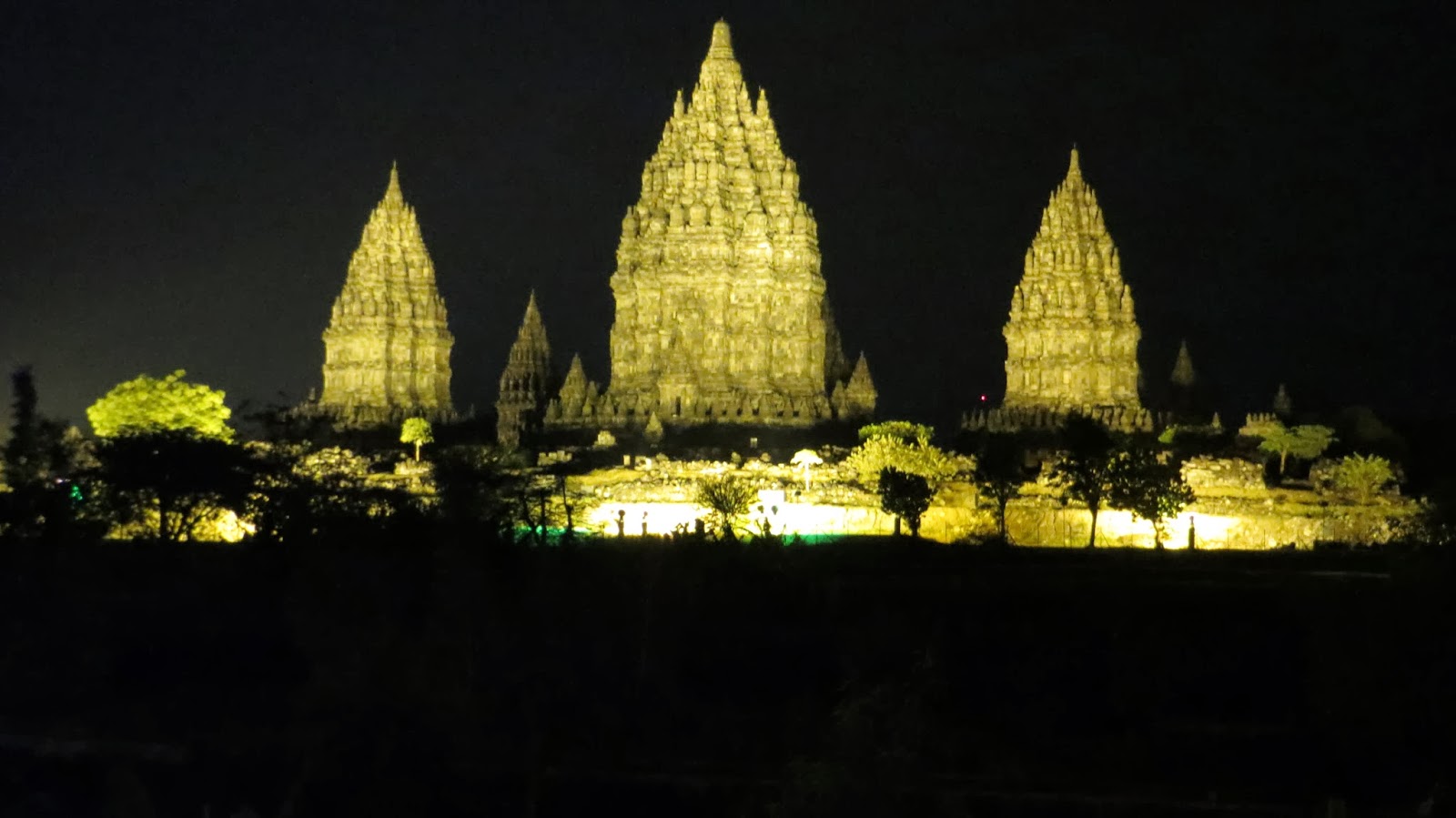
The major temple complex is a definite highlight. The Hindu “trinity” – the TrimÅ«rti – is expressed with three temples that are dedicated to the gods Brahma (the creator), Vishnu (the preserver) and Shiva (the destroyer). Around them there were more than 230 little temples of which only a few have been reconstructed. Ana and Simon shared a guide with a French tourist and he had some great stories to tell. The level of detail on the stone work was very impressive and really putting churches/cathedrals in Europe into perspective. At the end, they easily spent more than 2 hours at the complex. This way, they could also see the sun setting behind the temples. 
First impression of Prambanan
The main building for Vishnu
Many stone carvings, even more detailed than in Borobudur

Ganesha cannot be missed
Stunning lights
Ana had to touch many carvings for good luck and wealth (hope it works!)
The complex in the beautiful setting of the park
The sun is setting
Very happy with the light effects
One special feature of the Prambanan temple is that it acts as the background for an old and very colorful ballet – the Ramayana. This is a Hindu epic story - the Ramayana ballet is performed with the most amazing costumes, colors and make-ups by a sheer mass of 200 performing artists. After a good Indonesian dinner against the background of the lit Prambanan temple, the performance started at 7:30 PM. Although it also started to rain quite heavily in the middle of the show (and it was open air), it turned out to be a great spectacle and thus a Grande Finale of a long day. 
The background for Ana and Simon's dinner
The costumes, postures and make-up were beautiful
The show ended with parts of the stage set on fire (almost as in Hollywood)
Before heading back to Singapore, Ana and Simon also checked the Yogyakarta city center. Yogya is supposedly much less chaotic than other Indonesian cities and quite scenic.
The main draw of downtown Yogyakarta - the Kraton Palace
Well, everything is relative and they just realized that Indonesian temples, beaches and landscape are more beautiful.

Thursday, October 17, 2013

Hong Kong – the ”other” Singapore

After having seen the wilder parts of the Borneo jungles and rural sites in the Mekong Delta or the rice fields of Bali, Ana and Simon felt that they needed some new “big city vibes”. A very attractive flight offer then suddenly put Hong Kong on the map – despite being almost four hours away from Singapore. Ana and Simon went there for a three day weekend in September, leaving Singapore Friday morning and returning Sunday.

Simon had already been to Hong Kong in 2007, returning from his trip to Australia and New Zealand. Back then, he had, however, only seen the big city life. Thus, he was more than willing to explore Hong Kong “off the beaten path”. Since Ana has some colleagues from Hong Kong and Simon some classmates, they were well-advised what else to see beyond the famous Victoria Harbour.

Their first daytime excursion thus led them to the little village of Stanley on the South Coast of Hong Kong Island. Within less than 10km from the central district, there is a street market in a village that almost seems to have some type of Mediterranean flair. Ana and Simon really enjoyed strolling the alleys of the street market, stop for a coke and later lunch with some beers while looking at the piers and enjoying 30 Csunshine. Obviously, you cannot ignore that you are in one of the most densely-populated regions of the planet – there were big condominium buildings somewhat destroying the views of the country side but as long as they were in the back and out of the view, the impression of a Mediterranean fishermen village held up.

Hong Kong - really? Yes, the Southern part of HK Island
 
Almost Mediterranean feel
 Apparently, it gets even more original than that if you go to one of the 200 islands or to explore the “New Territories” (the mainland part of Hong Kong) on hiking trail. Unfortunately, Ana and Simon did not have the time to see the beaches or mountain regions there.

Other than the “not-expected” small-town vibe, Hong Kong obviously offers a lot of big-city charm. Ana and Simon headed to the Victoria Peak, the famous hill that provides breathtaking views over the harbour and the financial district of Hong Kong. It is incredible to see this place which has the largest number of skyscrapers in the world. As an international metropolis, Hong Kong also offered some great restaurants where Ana could indulge in mix of Western and Easter cuisine, either with nice views or with a prohibition style atmosphere and the most interesting drink selection. They even met with another INSEAD student and friends and partied one night in Hong Kong among many expats and Chinese alike.
View from a restaurant with delicious food

Dumplings at their best
Peking duck
The Bank of China building in the financial district
Ana and Simon at Victoria Peak
View of Victoria Harbour without tourists
Singapore and Hong Kong are quite alike in many aspects - both city states, both part of the "tiger states" of economic development in the 1970s to 1990s, both former British colonies with a predominantly Chinese cultural influence. The main difference is Hong Kong's proximity to China which makes the Chinese influence much more pronounced. Despite the fact that Hong Kong still has a currency and passports of their own, the city was always considered as a part of China whereas Singapore was "the little red dot" at the end of the Malaysian peninsula. All in all, Ana and Simon had the feeling that Hong Kong had somewhat of a more “real” city feeling and was a great getaway weekend, adding to the lists of South East Asian metropolis places.  

Thursday, September 26, 2013

Two nights in Bangkok


Remember the 80’s song: http://www.youtube.com/watch?v=P9mwELXPGbA? Well, Ana and Simon upgraded it from “One night in Bangkok” to two nights!

Ana has been working for more than half a year in Asia by now. She had hoped before that her work may allow her to do some business travel around the region. Finally, August presented a company training in Bangkok on a Thursday and Friday. She could check with Mercer and they allowed her to fly back to Singapore on Sunday instead and thus, Simon booked a flight to Bangkok to join her for the weekend. As they wanted to explore Thailand’s capital at some point anyhow, this basically just solved the question when to go there.

Simon met Ana in the afternoon of Friday. She staid in a down-to-earth business hotel in the Expat area of Bangkok, even though it still seemed pretty local to the European explorers. They went out for some drinks with Ana’s colleagues and continued to a pretty unique restaurant experience: “Cabbage & Condoms”. The food was mainly Thai and quite good. The interesting part of it was the decoration. All the lamps, pictures on the wall and lampions in the garden were created out of a multitude of different color-condoms. Other than that, the food was great and the atmosphere was a lot of fun. Saturday, they started their exploration of the city. All in all, Bangkok is a city full of contrasts. Ana and Simon did very “touristy” visits and major sightseeing, including temples, Thai houses and high rise buildings. 

In the garden of a very nice Thai building complex

Simon with the Thai ladies
A major temple in Bangkok
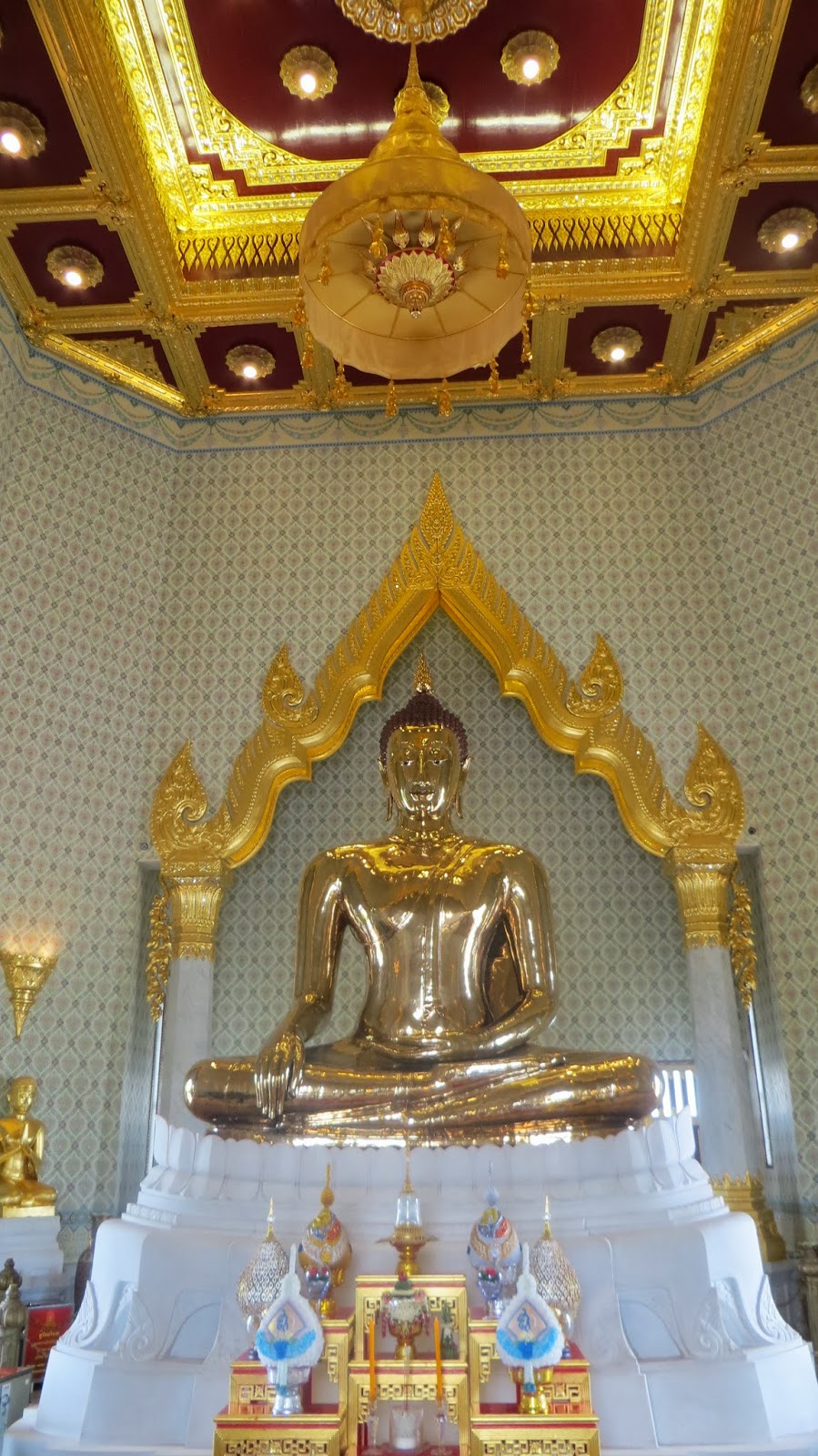
The massive 2.5 ton pure gold Buddha inside the temple
The gate to Chinatown against the background of the Golden Buddha Temple
On the other hand, the city life seemed to be unaffected by either the fact that millions of tourists visit Bangkok every year or that it is the Thai capital and by far the largest city of the country. Just a few dozen meters off the main roads, the life seemed to be much calmer and even more exotic than what the average tourist would see. One of the highlights that should be on the travel agenda for  every tourist is definitely the Grand Palace. Thailand was the only country in the region that remained independent from any colonial powers and can look back at a long history as an empire. However, it also never reached the scale or expansion of some European powers or China. Nevertheless, the Grand Palace stunned Ana and Simon much more than any palace they had ever seen in Europe. Sorry Buckingham Palace, move over Palacio Real, not good enough Neuschwanstein. It combines a spiritual part with a huge temple complex, thousand of golden tiles, grand architecture with the political power of the Thai kingdom and large representative buildings for state affairs. Words are barely enough to describe it. In case any of the readers ever travel to Bangkok, make sure to reserve three hours or more and get a local guide to explain you everything. Ana and Simon didn’t have the luxury of time but would have loved to do this.

Amazing murals on the inner walls of the Golden Palace
View of the palace complex
Spectacular temples inside the Grand Palace
Ana and Simon inside the Grand Palace
Doing his duty for Thailand

Golden tiles wherever you look
Huge warriors protecting some of the buildings inside the palace
The actual main palace building
Another, less expected, highlight were the buzzling streets of Chinatown. It is not the “usual Chinatown” that gets recommended in the guide books. Basically, Ana and Simon were looking for a ferry on the mighty Chao Phraya river when they decided to explore an alley with a few spice shops. One more turn and they were in the midst of Chinatown, the only Westerners and amazed by the variety of products, spices, fruits and everything on offer.

Different spices in Chinatown
Not many Westerners around...
... but fresh fruit juice everywhere
Another fun experience in Bangkok are the night markets. They are basically a combination of some original cultural heritage (many goods would have been sold at night when cooler temperatures would be better for the sale of perishable goods) with modern pleasures of shopping after business hours and eating out for dinner. A rather new night market is called Asiatique and is accessible with a water shuttle only. Ana and Simon could enjoy some great seafood with a nice atmosphere right next to the river. Also, they were able to enjoy the fact that Bangkok is home to rooftop bars about 200m above ground. Quite a nice atmosphere, even though the city is missing a skyline. That is what’s happening when there is no civil engineering as in Singapore.

All in all, Thailand’s capital and its friendly inhabitants proved to be a very good weekend destination. Definitely to be recommended!
Local transport: River boat with monks

When in Bangkok - travel by tuk-tuk